
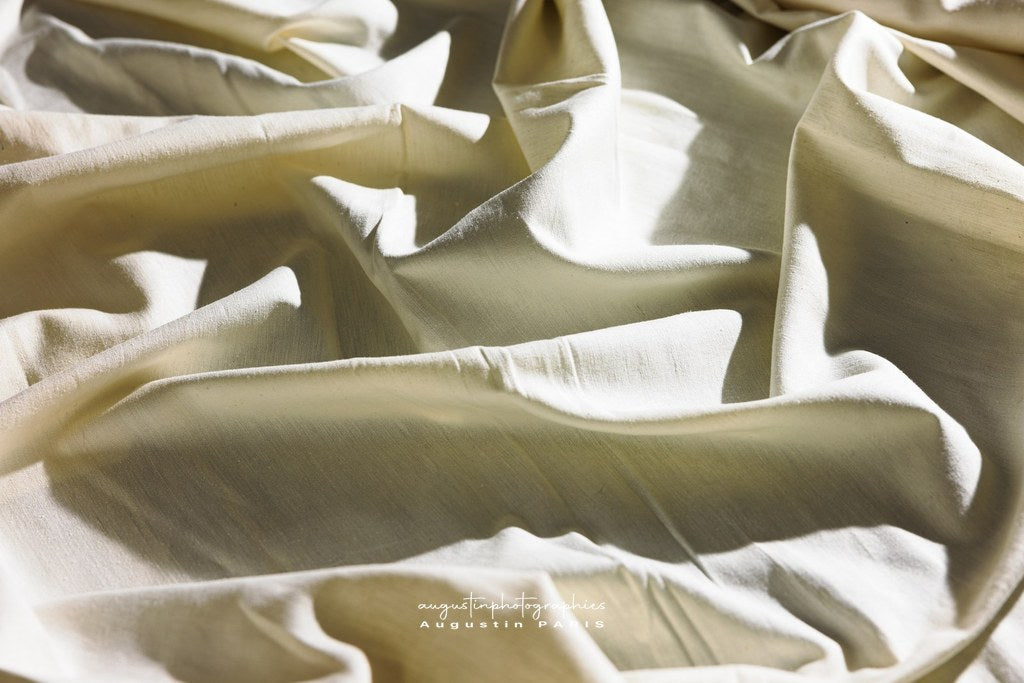
Material, recycling and responsible creation
Issue 1

There are clothes we buy, wear, and then forget.
And there are pieces we keep, because they carry something more than just a shape: a material, a gesture, a presence.
This first issue of the Ousman O. Journal starts with a simple question: what makes us want to keep a garment for a long time?
For over twenty years, I have been working with materials, bodies, gestures, and stories. I have learned that a garment never begins solely with a drawing. It often begins with an encounter: with a fabric, a texture, a color, a scrap, sometimes even a material that was thought to have no future.
In my journey as a designer, I have come to understand that a fabric can never be reduced to a surface. It already has a history. The designer's role is not to erase it, but to give it a new form.
From an era of repair to an era of replacement
For a long time, clothing belonged to the long term. It was taken in, transformed, patched up. A jacket could be adjusted, a shirt could become workwear, a material could have several uses before disappearing.
Not so long ago, clothes were passed down like material memories. A jacket, a coat, a shirt could evoke a loved one, a moment in life, a family story. These pieces sometimes passed from one generation to the next, because the material was beautiful, because the cut held up, because the garment had accompanied a life.
Throughout my travels and work, I have encountered cultures where reuse was not a trend, but a necessity. A garment could become household fabric, lining, accessory, or a repaired item. This intelligence of material existed long before we spoke of upcycling.
Someone I met there once told me that in the past, clothes from Europe were of good quality. They were resold, repaired, and truly contributed to the economic life of households. But I also saw the other reality: the massive arrival of synthetic clothes from developed countries has become, in some areas, a real environmental burden, difficult for local communities, who are not always equipped to deal with them, to manage.
This experience left a mark on me. It reminded me that responsibility begins before recycling: in the quality of what we produce, in the quantity we put into circulation, and in a garment's ability to remain useful, beautiful, and dignified over time.

Recycling is not erasing

Recycling is often presented as a simple solution. We collect, transform, and reuse. But in creation, recycling doesn't just mean giving a second life. It means looking differently at what seemed finished: a scrap, a forgotten garment, a dormant material, unused stock, a piece of fabric too small for classic production.
In the workshop, a scrap isn't necessarily waste. It can become a pocket, a lining, a yoke, a contrast, a trim, an accessory. It can also inspire an entire piece.
A fabric scrap sometimes holds the memory of a piece that doesn't yet exist. Placed on a table, almost forgotten, it can suddenly reveal a line, an association, a volume. That's where recycling becomes interesting for me: when it doesn't just fix a problem, but becomes a creative starting point.
|
To create sustainably is not just to produce differently. |
The words of matter
|
| Reuse: to use without deep transformation | Recycling: to transform for a new use | Upcycling: to create a higher value piece from an existing material | Repair: to extend the life of the garment |

Workshop notebook - what I keep
In the workshop, I often keep fragments of material. Some are too small to become a whole piece, but too beautiful to disappear: a strip of linen, a piece of printed cotton, a lining, a hemp scrap, a remnant of brocade, an old button.
This gesture is not just economical. It is creative. It forces one to look longer, to compose with what already exists, to accept that the material can guide part of the design.
At Ousman O., this attention can take several forms: keeping the most interesting scraps, imagining yokes, developing accessories in small series, working with dormant materials, designing reparable pieces, choosing fabrics that can last.
Creating less allows for better choices. It also allows more time to be devoted to the material, drape, cut, and finish. A limited series can become a way to respect available material and preserve the singularity of each piece.
Recycling is not enough
It must be said clearly: recycling alone cannot solve everything. A poorly designed garment, produced too quickly, made from a fragile material or one difficult to transform, will remain a problem, even if it eventually enters a recycling stream.
Responsible creation must therefore begin before recycling: in the design, in the choice of material, in the pattern making, in the cut, in the assembly method, in the quantity produced, and in the ability to repair.
The real question is not only: what do we do with the garment at the end of its life? The real question is also: why does this garment exist? This question forces each creation to find its necessity.

What lasting means
Ousman O. does not claim luxury as a status. I prefer to speak of high standards: high standards for material, gesture, time, cut, finish, and durability.
Ousman O.'s positioning is in contemporary high fashion: premium, responsible, and accessible pieces, created with a will for meaning, quality, and measure. Accessible does not mean ordinary. Responsible does not mean austere. Durable does not mean without emotion.
Ultimately, talking about recycling and responsible creation is to ask a simple question: what do we want to keep? To keep a material rather than throwing it away. To keep a gesture rather than erasing it. To keep a piece rather than replacing it. To keep a sensitive relationship with clothing.
At Ousman O., creating sustainably does not mean giving up on desire, elegance, or emotion. It means giving them more depth. A garment is not meant to be consumed and then forgotten. It can accompany a life, transform, be repaired, sometimes be passed on, and remain just over time.
Perhaps that, finally, is what lasting means.
O. The Workshop Journal.
To be continued
In the next issue of the Ousman O. Journal, we will continue this journey with an ancient material, long forgotten, now viewed differently: textile hemp.
A fiber of resistance, memory, and future.
The Workshop Journal - Issue 2: Hemp, memory of the future.