

Hemp jacket woven on a hand loom and reinterpreted in a contemporary silhouette. Presented during the European Heritage Days 2023.
“An old material is not an outdated material.
Sometimes it just needs a new form.”
For several years, I've often returned to natural materials. Not out of nostalgia, but because they carry a truth that overly smooth materials don't always possess.
Hemp is one of those fibers that doesn't immediately try to seduce. It doesn't present itself as a fragile or precious material at first glance. It asks to be touched, to have its grain, its drape, its density, its way of catching the light observed.
In the workshop, some materials command silence. Hemp is one of them. It tells a story longer than the garment itself: that of fields, gestures, uses, hands that cultivated, retted, defibrated, spun, and then wove.
After a first issue dedicated to longevity, it seemed natural to open this second journal with this ancient fiber. Because hemp poses an essential question for contemporary creation: with what do we want to build the clothes of tomorrow?
An ancient fiber
Before being rediscovered by sustainable fashion, hemp was part of everyday life. It was used for ropes, sails, bags, canvases, sheets, sturdy clothing, and household uses. It was a fiber of necessity, work, and resistance.
Hemp was not a material for rhetoric. It wasn't chosen to convey an ecological intention, but because it held up, because it resisted, because it served a purpose.
This idea greatly interests me. In an era where durability is often discussed, hemp reminds us that longevity is not just a contemporary value. It has long been a condition of life.
For generations, this fiber has been used in various ways. It belonged to an economy of necessity, where a material had to be strong, useful, transformable, and durable. Hemp reminds us that a material can be both humble and noble.

From field to fiber: hemp field and hackling of the tow. Excerpts from The savoir-faire of textile hemp. Credits: © Marie-Laure Sapin, 2020; © AFLAM Archives.
Disappear, then return
The decline of hemp also tells the story of our relationship with clothing. With the large-scale arrival of cotton, synthetic fibers, and ready-to-wear, certain demanding materials were gradually set aside. Not because they had lost their value, but because they required more time, more gestures, more attention.
Textile hemp is not easily transformed. One must understand the plant, separate the fiber, prepare it, spin it, weave it. One must accept that the material resists.
In a world that has accelerated greatly, a material that takes time becomes almost a form of resistance. It forces us to slow down, to look at the material before thinking about the product, and to rediscover the precision of the gesture.
From field to thread
Hemp begins in the earth. It grows tall and straight, with a stem that bears the fiber. But between the plant and the fabric, there is a long journey: cultivation, cutting, retting, defibration, hackling, spinning, then weaving.
Each step transforms the plant without completely stripping it of its character. Hemp fabric often retains something of this plant origin: a dry hand, a density, a lively irregularity.
Where some textiles seek a smooth perfection, hemp can maintain a more frank presence. It can wrinkle slightly, mark movement, and evolve with the body. This is not a flaw: it is a way of inhabiting the garment.

Material detail: fiber becomes surface, light and movement.
A sector to rebuild
Talking about hemp today is not just about talking about a fiber. It's about talking about a sector that needs to be rebuilt. France has a history with hemp, but between the memory of traditional skills and the reality of contemporary textile production, there are still fragile steps.
Transforming hemp into a long, fine fiber suitable for clothing requires tools, trials, adjustments, and knowledge transfer. This resurgence relies on farmers, artisans, weavers, processors, researchers, brands, and workshops that agree to work with a demanding material.
It is in this spirit that I look at Virgocoop. I see it not just as a material supplier, but as a collective dynamic around a fiber to be put back in motion. As a member, this connection makes sense to me: it inscribes creation within a broader relationship, between agriculture, textiles, territory, craftsmanship, and responsibility.
A responsible material doesn't become right just because it's natural. It becomes right when it's cultivated, processed, designed, cut, and used with consistency.

Departmental Archives of the Marne, textiles and samples: the memory of patterns, writings, and weaving gestures of artisans.
A living heritage experience
This reflection on hemp is not merely theoretical. It is also part of my journey as a designer.
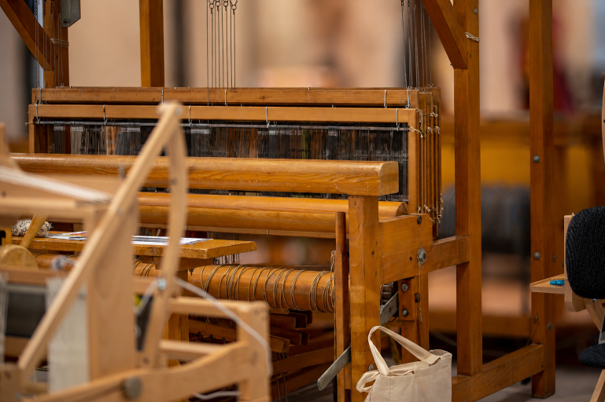
In 2023, for the European Heritage Days, I designed a hemp jacket whose weaving was done on one of my large, fifty-year-old, 8-shaft hand looms. This loom had belonged to Daniel Algranate, a great weaver who has since passed away.

Hand loom: the ancient tool as a memory of gesture and starting point for contemporary creation.
Working on such a tool is never insignificant. It's not just about producing a fabric. It's about bringing an ancient material, a transmitted gesture, a tool steeped in memory, and contemporary creation into dialogue.
From this textile, I designed and made a hemp jacket in my workshop. I incorporated ancient motifs, revisited through my contemporary designer's eye, with a modern cut, closer to today's wardrobe.
The piece was then exhibited in a museum, where the general public could discover it. This moment left a mark on me. People of all ages stopped in front of this jacket, not only to look at its form, but to understand its material, its weaving, its history, and its connection to heritage.
I felt that hemp was then regaining a sensitive place. Not as a material of the past, but as a fiber capable of speaking again in the present. An ancient material that, once placed back in the hands of a workshop, can still touch, surprise, and conquer.

The jacket presented at the museum during the European Heritage Days 2023.
Why hemp speaks to our time
Our era produces many materials, many clothes, many volumes. In this context, returning to a fiber like hemp is not a step backward. It is a way of asking another question: how to produce better? with what materials? for what uses? for what duration?
Hemp does not answer everything. No single material alone solves the problems of the textile industry. But it opens a path: that of an ancient, robust, simple plant fiber, capable of finding a place in a contemporary wardrobe.
It reminds us that a material can be both ancient and deeply current. It can come from the past and help us think about tomorrow.
In the Ousman O. workshop
In the Ousman O. workshop, I am interested in hemp for its simplicity, its hold, and its ability to provide structure without making the garment rigid.
For this ecru hemp jacket, I wanted to maintain a clear and contemporary cut, with functional lines, visible pockets, and a material left almost silent. The garment doesn't seek effect: it lets the grain, light, and density of the fiber speak for themselves.
For me, working with hemp is not just choosing a natural material. It's seeking coherence between design, gesture, use, and longevity.

Ousman O. ecru hemp jacket: a contemporary cut that lets the material speak for itself. Photo: Augustin Photographies.
The words of hemp
|
A material of resistance
What I find beautiful about hemp is that it isn't content with just being a natural material. It carries an idea of resistance: resistance of the fiber, resistance of savoir-faire, resistance to oblivion, resistance to the homogenization of materials.
In a contemporary wardrobe, this resistance can become elegant. It can give rise to more understated, more structured, more durable, and also more sensitive garments.
Hemp invites us not to confuse modernity with novelty. A material can be ancient and profoundly current. It can come from the past and help us think about tomorrow.
Conclusion
Hemp is not returning to imitate the materials of the past. It is returning because it can help us imagine fairer garments: less rushed, more structured, more attentive to material and time.
In this fiber, I see a form of memory. But an active memory, oriented towards the future. A memory that doesn't just ask to be preserved, but to be set in motion again in fields, workshops, garments, and gestures.
After exploring the meaning of durability, this second issue offers a possible answer: to endure also means to choose materials capable of withstanding time.
- Ousman O. Journal
Coming Soon
In the next issue of the Ousman O. Journal, we will continue our exploration of natural fibers with a material related to hemp: linen. A fiber of light, freshness, and precision.
Ousman O. Journal - Issue 3: Linen, the Light of the Thread
Ousman O. - Material, Gesture, Time